edit_note HeyLead product · Content system

HeyLead Auto Blogger: publish SEO-ready niche content without babysitting a calendar

Research, draft, enrich, validate, and publish blog posts on a schedule - with human review when you want it. Built for agencies and growth teams that need consistent topical coverage across local service industries.

WordPress REST out of the box. Static and Git-based sites supported. Multi-client playbooks, quality grades, and daily digests in one dashboard.

  • check_circle Quality grades A+ to F
  • check_circle WordPress + static publish
  • check_circle Multi-client playbooks
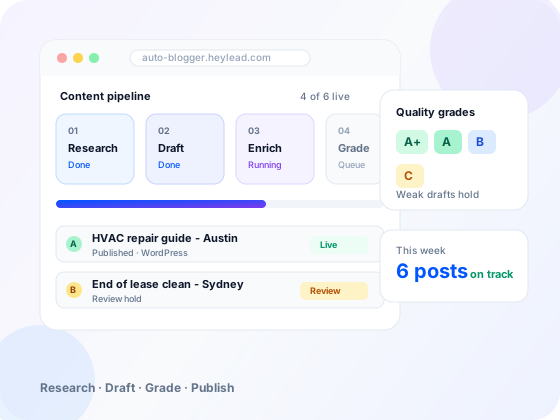
HeyLead Auto Blogger pipeline dashboard with quality grades and weekly publishing schedule
travel_explore

Research

Keyword context from playbooks

edit_note

Draft under brand voice

Stable prompt + per-post brief

verified

Validate and grade

A+ to F - weak drafts hold

cloud_upload

Publish or review

WordPress or static Git

Ideal for home services, cleaning, health clinics, real estate, security, energy, auto, and multi-niche operators

Why clients use it

Benefits that show up in the content calendar and the pipeline

HeyLead Auto Blogger is not a one-off writing shortcut. It is an operational content system: briefs, quality gates, CMS publish, and multi-client control so marketing stays consistent without burning your team.

Content calendar with scheduled posts
calendar_month

Reliable publishing cadence

Stop feast-or-famine content. Schedule research-to-publish runs so every client gets topical posts without weekly scramble meetings.

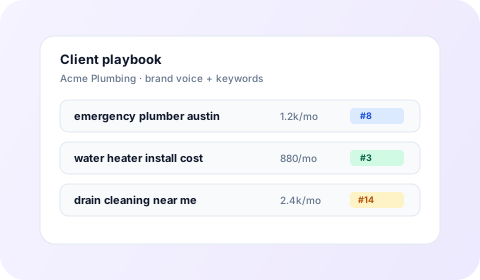
Keyword playbook with volume and rank
track_changes

Keyword-aware, client-specific

Each client has a playbook: global writer voice, target keywords with volume and rank context, testimonials, and seed data. Output matches the brand, not a generic blog tone.

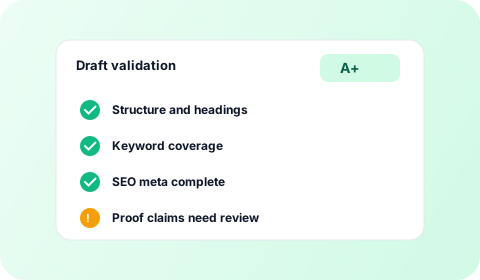
Draft validation with letter grades
verified

Quality gates before it goes live

Validation surfaces letter grades from A+ through F in the review UI. Weak drafts hold for human approval instead of polluting the blog with thin filler.

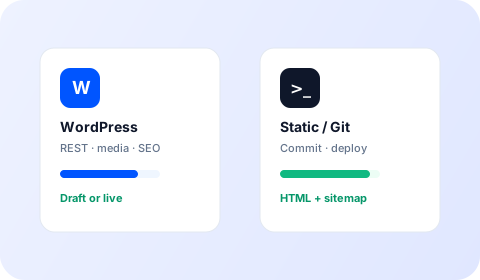
WordPress and static Git publish targets
language

Publishes where your site already lives

WordPress REST for classic sites. Static/Git publishers for modern JAMstack sites. Per-client target selection - no one-size publish path forced on everyone.

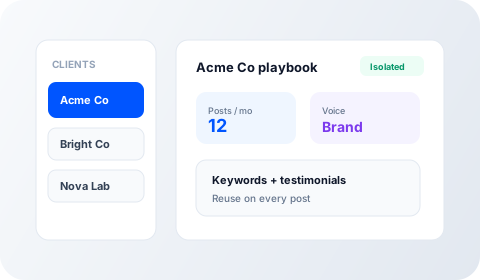
Multi-client isolated playbooks
groups

Built for agencies and multi-brand teams

One platform, many clients. Shared pipeline stages with isolated playbooks, so you scale content ops without cloning tools per account.

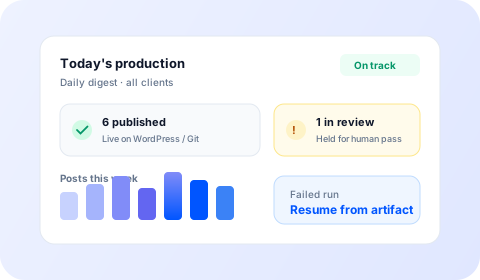
Daily digests showing published posts, review holds, and job recovery
mark_email_read

Daily digests and job recovery

See what published, what is held for review, and resume failed runs from durable artifacts - so production never goes dark without notice. Flat monthly plans, not metered spend dashboards.

What improves when content compounds

Rankings and organic traffic move together when cadence is real

Illustrative pattern from multi-niche local SEO programs where topical posts ship on a fixed schedule, internal links point at money pages, and weak drafts never go live. Results vary by market competition and baseline; the graph shows the shape teams usually aim for over six months of consistent publishing.

6-month content system trajectory

Indexed commercial queries vs organic sessions (illustrative)

Avg. ranking position (lower is better) Organic sessions index
M1 M2 M3 M4 M5 M6 #10 #20 #30 #40 #50

Illustrative composite, not a guarantee. Rank axis inverted so improving positions rise on the chart. Pair content with technical SEO, internal links to service pages, and conversion tracking for revenue impact.

Avg. commercial rank

#28 → #12

Improving over 6 months

When niche pages ship weekly and target real service + city intent, average position on priority queries typically tightens instead of bouncing week to week.

Organic sessions

+110% index

Traffic compounds with inventory

New posts expand the query footprint. Older posts keep earning once internal links and updates keep them fresh.

What HeyLead Auto Blogger contributes

Cadence, niche coverage, quality gates, and publish reliability - so SEO strategy is not blocked by writing capacity.

How it works

From brief to published post in a controlled pipeline

Every stage writes durable artifacts. If a run fails mid-way, it resumes cleanly. You choose auto-publish or human review per client.

01

Client playbook

Seed voice, keywords, proof points, industries, and publish rules once. The system reuses that context on every post so quality does not depend on who typed the brief that day.

02

Research and outline

High-signal research (when enabled for the client) plus a structured outline aligned to the brief - intent, sections, and commercial angle before prose is generated.

03

Draft under brand rules

A stable global writer prompt (system) plus a per-post brief (user) drive drafting. That split keeps voice consistent while topics stay niche- and region-specific.

04

Enrich

Featured and inline media, taxonomy hooks, and SEO meta for WordPress (Yoast / Rank Math fields) or static HTML layouts used by modern marketing sites.

05

Validate

Automated checks grade the draft from A+ through F. Pass thresholds can auto-advance; fails land in a review queue so editors fix or reject before publish.

06

Publish

WordPress: create draft or live posts via REST with media and taxonomies. Static: render full HTML, patch index and sitemap, commit to GitHub for deploy.

Reviews

What operators say about consistent content systems

Composite-style reviews based on common outcomes from multi-niche SEO and lead-gen programs. Names are role and industry only - not real client quotes.

star star star star star
“We stopped waiting for a monthly content meeting. Plumbing and HVAC posts ship on a schedule, and our service pages finally have internal links that matter.”
Ops Manager · Multi-trade home services · US Midwest
star star star star star
“Quality grades saved us. Thin drafts never hit WordPress. Editors only touch the ones that need a human pass.”
Marketing Director · Commercial cleaning group · Australia
star star star star star
“Dental and aesthetics content used to stall for weeks. Now we publish niche pieces by region without hiring another writer.”
Clinic Marketing Lead · Multi-site dental · Singapore
star star star star star
“Git publish fits our static site. Posts, hub, and sitemap update together so we are not hand-editing deploys every Friday.”
Head of Growth · Property management · UK
star star star star star
“Solar and battery pages need seasonality. Scheduled topics mean monsoon and rebate windows are covered before competitors notice.”
Founder · Energy and solar installer · Australia
star star star star star
“Agency-side, multi-client isolation is the point. Each brand keeps its voice and keywords. We run one pipeline without mixing clients.”
Agency Partner · Local services portfolio · US
star star star star star
“Locksmith content is urgent and local. Having region-aware posts ready meant paid search finally had organic support pages that match the ads.”
Owner · Residential and auto locksmith · Singapore
star star star star star
“Daily digests keep us in control. We know what published, what failed, and what is waiting for review - without logging into five tools.”
COO · Multi-location auto services · US Southwest
star star star star star
“MedSpa topics need careful claims. Human review mode lets us approve language before anything is public, while still shipping weekly.”
Clinic Director · Medical aesthetics · US West Coast
star star star star star
“We treat content like a product now. Playbooks, schedules, and grades made SEO feel operational instead of creative chaos.”
VP Marketing · Multi-brand retail services · UK

CMS and hosting

Works with the stacks your clients already use

Publish targets are selected per client. Adding a new target is additive - it never rewrites the orchestrator. WordPress is first-class; modern static sites are first-class; other CMS paths can be added as publishers when a client needs them.

language

WordPress

REST API · drafts · media · SEO plugins

  • check_circleCreate posts as draft or publish live
  • check_circleUpload featured and inline images
  • check_circleTaxonomy creation and assignment
  • check_circleYoast / Rank Math meta fields
  • check_circleProven on multi-client agency sites
code

Static / Git sites

GitHub commit · host webhook deploy

  • check_circlePer-client HTML renderer (brand layout, CTAs)
  • check_circleBlog index and sitemap updates in one commit
  • check_circleWorks with Cloudflare Pages, Netlify, Vercel-style flows
  • check_circleIdeal for headless marketing sites without WordPress
  • check_circleAtomic publish: content + index stay in sync

Top CMS platforms we can publish to

WordPress and static/Git are production-ready today. Everything else rides the same publisher architecture: if the platform has a REST or GraphQL content API, a webhook, or a Git export path, we can add a module without rebuilding the pipeline. Here are the top CMS stacks teams ask about most:

WordPress WordPress VIP / managed hosts Static / Astro / Next.js GitHub-backed blogs Shopify Webflow Wix Squarespace Drupal Joomla Ghost HubSpot CMS Contentful Sanity Strapi Craft CMS TYPO3 Adobe Experience Manager Sitecore Duda Framer Payload CMS Directus Storyblok

Highlighted items are first-class today. Others are available via config, a small publisher module, or scoped integration work. If your CMS is not listed, tell us - we will say whether it is a quick fit or not yet.

Cost and speed

Faster growth than typing every post by hand - without a writing department

Most teams either write slowly in-house or pay freelancers, contractors, editors, and project managers for every article. HeyLead Auto Blogger replaces that scramble with a research-to-publish system so you ship niche SEO content weekly and compound organic demand instead of waiting on capacity.

edit_document

Not "just type into a chatbot"

Chat tools draft text. You still research, structure, fact-check, write meta, upload images, schedule CMS publish, and chase freelancers. HeyLead Auto Blogger runs that whole pipeline with playbooks, grades, and schedules.

payments

Beats Fiverr, Upwork, and premium freelancers

Even at $10-$15/hr on gig platforms, a full post is still hours of research, draft, review, polish, meta, and CMS work - plus your time managing gigs. Premium freelancers and agencies stack thousands more. HeyLead Auto Blogger folds that workflow into one flat monthly system.

rocket_launch

Grow coverage while competitors stall

Consistent niche and region pages are how local service brands win long-tail demand. When you publish on a fixed cadence, indexation, topical depth, and internal links compound. Missed months mean competitors own the SERPs instead.

Illustrative monthly math

What 20 SEO posts / month usually costs

Includes Fiverr and Upwork-style gigs at $10-$15/hr, premium freelancers, and agencies. Hour math assumes a full article workflow - not a bare draft dump.

  • checkResearch keywords, SERP, and brief
  • checkDraft niche-aware long-form copy
  • checkReview & polish structure, claims, tone
  • checkSEO + publish meta, media, CMS upload

Compare to Growth at $500/mo for up to 24 articles: often under $25 effective per published post when you use the full allowance.

Path How cost is built Typical / post 20 posts / mo Vs Growth $500
In-house marketer writing alone 4-8 hrs labour + opportunity cost High soft cost Calendar stalls; other growth work slips Time freed for strategy
Fiverr / Upwork at $10/hr ~5-7 hrs: research, draft, review, polish, SEO, upload $50-$70 $1,000-$1,400 Save ~$500-$900
Fiverr / Upwork at $15/hr Same full workflow (~5-7 hrs); rework often pushes higher $75-$105 $1,500-$2,100 Save ~$1,000-$1,600
Freelance writer + editor Per-word or per-post + edit + PM time $300-$750 $6,000-$15,000 Save ~$5,500-$14,500
Content agency / contractors stack Writer + editor + account markup $400-$900+ $8,000-$18,000+ Save ~$7,500-$17,500+
HeyLead Auto Blogger (Growth) Research → draft → validate → polish → publish pipeline, flat plan From ~$21 at full 24-post use $500 flat Baseline

Even cheap gigs lose on hours

At $10-$15/hr, 20 solid posts still cost roughly $1,000-$2,100/mo in labour alone - before platform fees, revisions, and your time briefing freelancers. Growth is $500.

System beats one-off deliverables

Fiverr/Upwork give you files. HeyLead Auto Blogger gives you playbooks, quality grades, review hold, schedules, digests, and CMS publish - so research, draft, review, and polish are not rebuilt from scratch every post.

Illustrative only: real Fiverr/Upwork quotes and rework rates vary. The point is that full SEO production is multi-step labour even at low hourly rates - and HeyLead Auto Blogger still wins on cost while shipping more consistently when freelancers go quiet.

Pricing

Three clear plans. Pick your monthly article volume.

Every plan includes the full pipeline: research context, outline, draft, enrichment, quality grades, and publish to WordPress or static/Git when configured. Scale volume and multi-client coverage as you grow.

Starter

$300 / month

For a single brand ready to replace ad-hoc blogging with a fixed cadence.

  • articleUp to 12 articles per month
  • short_text~1,200-1,500 words per article target
  • store1 brand / site playbook
  • verifiedQuality grades A+ to F + review hold
  • cloud_uploadWordPress or static/Git publish
  • mailRun digests and publish status

Effective from ~$25 per article at full use - still a fraction of a freelance brief.

Start with Starter
Most popular

Growth

$500 / month

For growth teams and small agencies that need real topical coverage every week.

  • articleUp to 24 articles per month
  • short_text~1,500-2,000 words per article target
  • groupsUp to 3 brands / clients with isolated playbooks
  • track_changesKeyword playbooks with volume and rank context
  • rate_reviewHuman review queue + optional auto-publish
  • rocket_launchPriority onboarding and schedule design

At full use, about $21 per article end-to-end - research through publish-ready output.

Choose Growth arrow_forward

Scale

$750 / month

For multi-niche and multi-region operators who treat content like a production line.

  • articleUp to 40 articles per month
  • short_text~1,800-2,500 words per article target
  • apartmentUp to 8 brands or multi-region rotation
  • publicMulti-market / multi-language playbook support
  • paymentsDaily digests, review holds, and ops visibility
  • support_agentDedicated setup for agency and multi-site stacks

About $19 per article at full use - built to outpace teams still briefing freelancers one by one.

Scale with Scale
schedule

Configurable cadence

Daily slots, multi-post days, or weekly batches. Caps protect quality when volume is high.

swap_horiz

Change plans as you grow

Start on Starter, move to Growth or Scale when keyword inventory and markets expand. No need to rebuild process.

handshake

Talk before you buy

We map industries, CMS, and review policy first so the plan matches real capacity - not a vanity article count.

Compared to alternatives

Why operators pick HeyLead Auto Blogger over other AI writers

Soro, Jasper, Writesonic, Surfer, Content at Scale, and Koala each solve a piece of the problem - daily autopilot, drafting, or SEO scoring. HeyLead Auto Blogger is a multi-client operations system with quality gates, human review, and publish paths built for local and multi-region service SEO.

Capability HeyLead Auto Blogger Soro Jasper Writesonic Surfer SEO Content at Scale Koala
Full research → draft → validate → publish pipeline Yes - core product Research + write + publish Draft-focused Draft-focused Optimise / editor High-volume AI Generation-focused
Multi-client agency playbooks Built-in isolation Single-site style Brand voices only Limited Not ops-centric Limited Single-user style
Letter-grade quality gates (A+ to F) Yes, with hold rules No letter-grade hold system No No Content score (different model) Limited Limited
WordPress + static / Git publish First-class WP + Shopify etc. Integrations vary Plugins / export Not full CMS ops Varies Limited
Local niche & multi-region service SEO Designed for it General autopilot General marketing General marketing General SEO General volume General
Human review queue before live Native workflow Optional edit Manual outside tool Manual outside tool Manual Manual Manual
Ops digests, resume-from-failure, review holds Yes Basic SaaS usage Usage / seats Credits Credits Credits Credits
Flat monthly article volume pricing $300 / $500 / $750 From ~$39/mo plans Seat / word models Plan / credit models Seat / credit models Volume packages Word / plan models

Competitor features change over time. Positioning is based on public product claims. Use this to decide what you are buying - a daily SEO autopilot, a drafting assistant, an SEO score, or a quality-gated multi-client content production line.

Bottom line

Ship more of the pages that win enquiries - for a fraction of contractor cost

When content ops stop depending on freelancers or unreviewed AI dumps, companies cover more niches and regions, protect quality, and grow organic pipeline. That is the advantage of HeyLead Auto Blogger over typing, freelancers, and one-off AI drafts.

FAQ

HeyLead Auto Blogger questions, answered

Practical answers for agencies, in-house marketers, and multi-location operators evaluating a managed content system.

What are the HeyLead Auto Blogger prices?expand_more
Three monthly plans: Starter at $300 (up to 12 articles, ~1,200-1,500 words, 1 brand), Growth at $500 (up to 24 articles, ~1,500-2,000 words, up to 3 brands), and Scale at $750 (up to 40 articles, ~1,800-2,500 words, up to 8 brands or multi-region). All include the research-to-publish pipeline and quality grades. See pricing for the full breakdown.
How much can we save versus Fiverr, Upwork, freelancers, and editors?expand_more
Even cheap Fiverr/Upwork rates of $10-$15/hr still add up: a full post is roughly 5-7 hours of research, draft, review, polish, SEO meta, and CMS upload - about $1,000-$2,100 for 20 posts before fees and rework. Growth at $500 still saves hundreds to over a thousand dollars a month on that path. Premium freelancers and agencies often run $6,000-$15,000+ for similar volume. You also get playbooks, quality grades, and scheduled publish - not one-off gig files. See the savings table for the full breakdown.
Is HeyLead Auto Blogger only for WordPress?expand_more
No. WordPress is the most common path because REST, media, and SEO plugins are mature. Static and Git-based publishers are production-ready for modern marketing sites. Other CMS platforms can be added as publishers when there is a usable API, webhook, or Git workflow. We will tell you honestly if a stack is a config job, a small build, or not a fit yet.
Can humans still review content before it goes live?expand_more
Yes. Auto-publish is a setting, not a requirement. Drafts can hold in a review queue until an editor approves, edits, or rejects them. Validation grades help prioritise what needs a human pass. Many teams start in review mode for regulated or brand-sensitive niches, then open auto-publish on safer topics later.
Will posts sound generic or like every other blog?expand_more
Each client has a writer playbook and per-post brief structure, including voice, keywords, and proof points. Niche and region context are part of the brief so a plumbing post in Texas does not read like a dental post in Singapore. Quality gates catch thin or repetitive drafts before they publish. Strong results still depend on good keywords, real examples, and updates over time.
Which industries is HeyLead Auto Blogger built for?expand_more
It is strongest for local and specialist service businesses that need ongoing niche content: home services and trades, cleaning, real estate and property, health and wellness, locksmith and security, energy and home improvement, auto services, beauty, hospitality, and similar multi-location or multi-niche operators. Agencies running many of those clients in one stack get the most leverage. Pure brand journalism sites can use it, but the product design assumes commercial SEO and lead-gen goals.
How is this different from pasting into a chatbot?expand_more
Chat tools help draft text. HeyLead Auto Blogger runs an operations pipeline: playbooks, research, outlines, enrichment, validation grades, publish targets, schedules, digests, and multi-client isolation. That is the difference between a one-off article and a system that still works when your team is busy. Editors and strategists stay in control of topics, claims, and when something is allowed to go live.
How does HeyLead Auto Blogger compare to Soro (trysoro.com)?expand_more
Soro (trysoro.com) is a DIY SEO autopilot: keyword ideas, daily AI articles, and connectors for WordPress/Shopify-style sites at a low monthly entry price. HeyLead Auto Blogger is for teams that need quality gates (A+ to F), multi-client playbooks, human review holds, multi-region niche SEO, digests and review holds, and static/Git publish - not only "publish every day while you sleep." See the comparison table for Soro alongside Jasper, Writesonic, Surfer, and others.
What are validation grades (A+ through F)?expand_more
After drafting, automated checks score structure, length, SEO meta, required sections, and other quality rules. The overall letter grade makes weak drafts easy to spot in the review UI. High grades can advance automatically if you allow it. Low grades hold for human review so thin or broken posts do not land on the public site.
Can we run multiple clients on one pipeline?expand_more
Yes. That is a core design goal. Each client has its own playbook, keywords, publish target, and schedule settings. Stages are shared so the team learns one workflow, but brand voice and CMS destinations stay isolated. Agencies use this to scale content ops without cloning tools for every account.
How often can we publish?expand_more
Cadence is configurable per client: daily slots, multi-post days, weekly, or custom schedules. Monthly caps protect budget and quality when volume is high. The right pace depends on keyword inventory, review bandwidth, and niche competition. We help set a schedule that compounds SEO without flooding the site with low-value posts.
Does HeyLead Auto Blogger replace SEO strategy?expand_more
No. Strategy still decides which niches, regions, and intents deserve pages, how internal links flow to money pages, and what claims are safe. HeyLead Auto Blogger executes the content operations layer so strategy is not blocked by writing capacity. Best results come when keywords, site architecture, and conversion pages are already thought through.
Can posts target different regions or languages?expand_more
Yes. Briefs carry region, locale, terminology, and routing so articles are market-native rather than country-name swaps. English markets are the most common path today. Spanish and other language bodies are supported when the playbook and review process are set up for them. Multi-region hubs can share a system while keeping local voice.
What happens if a run fails mid-way?expand_more
Stages write durable artifacts so work can resume without starting from zero. Failed runs surface in digests and the dashboard with enough context to retry or fix. That reliability matters when you publish at volume across many clients. You should still monitor digests; no pipeline is “set and forget forever.”
How do images and SEO meta get handled?expand_more
Enrichment can attach featured and body images with attribution where required, plus categories, tags, and meta title/description fields. WordPress clients can map to Yoast or Rank Math meta. Static sites receive meta in the rendered output your theme expects. Editors can still override media and meta when a niche needs brand photography.
Is this safe for medical, legal, or regulated claims?expand_more
Use human review for regulated niches. Playbooks should ban unsupported claims, and reviewers must approve clinical or legal language before publish. HeyLead Auto Blogger helps with cadence and structure, but compliance ownership stays with your team and licensed professionals. Many clinics keep review mode permanent for treatment pages and allow auto-publish only for lighter educational topics.
Will this hurt SEO if Google devalues low-quality content?expand_more
Thin, unreviewed mass publishing can hurt any site - including one written by hand. HeyLead Auto Blogger is designed to reduce that risk with briefs, validation grades, optional human hold, and niche-specific playbooks. Strategy still matters: target real commercial queries, link to service pages, and prune or improve underperformers. Volume without quality is not the goal.
How long until we see ranking or traffic gains?expand_more
Organic results are rarely overnight. Many multi-niche programs show clearer movement over a few months of steady publishing, internal linking, and technical health. Competitive metros and new domains take longer. We set expectations around leading indicators first - indexation, impressions, query coverage - then clicks and leads. Paid channels can still drive revenue while organic compounds.
Can HeyLead Auto Blogger support multi-location service pages and blogs together?expand_more
Yes, when the architecture is planned. Blog posts can target niche-by-region intent and link into location or service money pages. The system does not replace a proper location page template, but it feeds those pages with supporting content. We recommend a clear taxonomy so cities, services, and industries do not cannibalise each other.
How do agencies track cost across clients?expand_more
Plans are flat monthly fees with clear article allowances - not metered API spend dashboards. Daily digests summarise what published, what failed, and what is held for review so delivery stays aligned. Resume-from-failure keeps long runs recoverable. That operational clarity is hard to get when freelancers and one-off tools are scattered across accounts.
Do we keep ownership of content and CMS accounts?expand_more
Yes. Publish destinations stay in the client’s CMS or Git repo under their control. Content published to their site is their asset. Playbooks and process live in the HeyLead Auto Blogger admin for operational continuity. There is no hostage dynamic around locked CMS logins when setup is done correctly.
What do we need to start?expand_more
A clear niche map, target keywords, brand voice notes, CMS access or Git repo, and a decision on review vs auto-publish. Prefer industries and regions with real commercial intent. A short kickoff seeds the playbook, schedules the first wave, and defines who approves what. From there, cadence is the product.
How do we get started with HeyLead?expand_more
Contact us with your CMS, industries, markets, and desired volume. We will recommend a schedule, review policy, and playbook shape. If you are unsure about content opportunity, start with a free audit of SEO and lead gen so the first topics are worth publishing. Then we wire HeyLead Auto Blogger into your real stack.

Pick a plan. Start compounding content this month.

Starter $300, Growth $500, or Scale $750 - with article counts, word targets, and multi-client options that beat freelancers on cost and beat chat tools on operations. Tell us your industries, CMS, and review policy.