
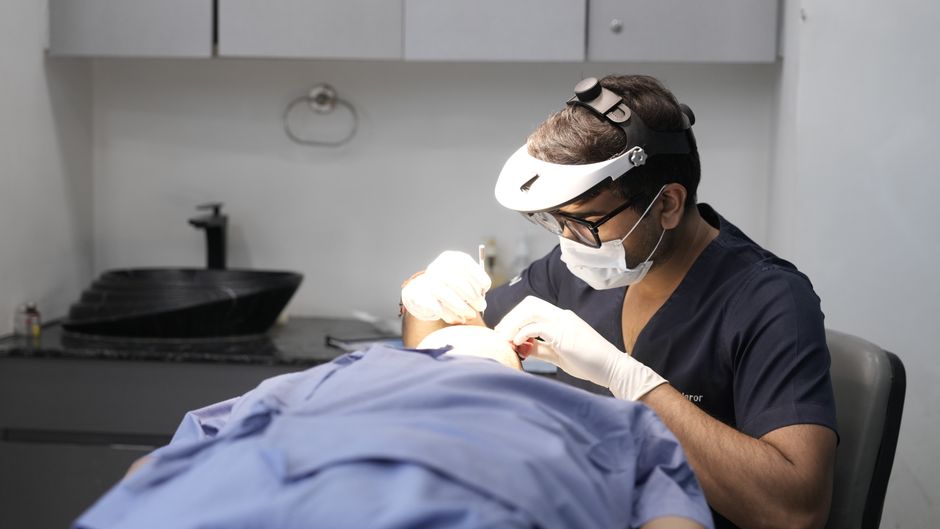
A gallery with hundreds of before-and-after photos feels like proof. To Google, most of those images are invisible text-less blobs with no alt copy, no unique file names, and no indexable context. And next to that gallery, on the review platform where a nervous guy is scrolling at midnight, a chunk of the five-star reviews underneath it might be the kind the FTC’s 2024 rule now treats as illegal.
That’s the uncomfortable part. Clinics spend real money building the exact assets they think convert skeptics into consults, the photos, the testimonials, the “our results speak for themselves” page, and a lot of that spend never reaches the patient searching “FUE hair transplant near me” tonight. The consult slot that should’ve gone to your practice books with a competitor three exits down the highway instead, because their gallery page actually ranks and their reviews won’t trigger a platform takedown next quarter. Add more ad spend and the math doesn’t change. A wider radius on Google Ads just buys you more clicks to a page Google already can’t read.
Here’s the part worth sitting with: it’s rarely a strategy problem. It’s usually five or six specific, repeatable mistakes, the same ones, clinic after clinic, state after state. Fix those and the existing content usually does more work than a rebuild would.
The gallery, the reviews, and the five other places hair restoration SEO actually breaks down
These aren’t abstract “SEO best practices.” They’re specific things a developer configured, or a front-desk manager set up two years ago, that are quietly capping how many consults your practice books.
Common mistakes
-
1Before-and-after galleries built for scrolling, not for Google
Huge image sliders, lazy-loaded thumbnails with filenames like IMG_4821.jpg, zero alt text describing the procedure, graft count, or timeline, and the same "after" shot reused across three location pages. Google can't read a slider the way a patient can, and if the image never gets described in text, it never ranks for "FUE results after 8 months" or "hair transplant scar at the back of the head." Fix it by converting the gallery into real indexable pages, one per case if you can, with a short caption describing procedure type, graft count range, and months post-op, plus compressed WebP files with descriptive names.
-
2Review practices that run straight into the FTC's 2024 rule
The FTC's rule on fake and deceptive reviews, finalized in 2024, bans undisclosed incentivized reviews, insider reviews from staff or their families without clear disclosure, and review suppression that buries only the negative ones. A lot of hair restoration practices still run a version of "leave us five stars and get $50 off your next treatment" without any disclosure language, which is exactly the pattern the rule targets. Beyond the legal exposure, review platforms are getting faster at purging flagged reviews in bulk, and a sudden drop of thirty or forty reviews can tank your Google Business Profile's local ranking overnight. Fix it by auditing how reviews get requested, disclosing any incentive clearly, and asking for reviews from the full range of outcomes, not just the dream results.
-
3One catch-all page trying to rank for FUE, FUT, DHI, PRP, and SMP at once
A single "Hair Restoration Services" page that mentions five different procedures in passing can't compete with a competitor's dedicated FUE page, dedicated scalp micropigmentation page, and dedicated PRP page. Google reads intent, and someone searching "DHI hair transplant cost" wants a DHI page, not a paragraph buried under four other procedures. The practical fix is to split the catch-all page into procedure-specific pages, each with its own recovery timeline, candidacy notes, and pricing range, and let the overview page link out to them instead of trying to cover everything itself.
-
4Multi-location pages that are the same page with the city swapped
Scope-of-practice rules for who can perform extraction and implantation, physician versus technician, with or without direct supervision, vary a lot by state, and a copy-pasted location page that ignores that reads as generic to both patients and Google. When every location page shares the same physician bio, the same three paragraphs, and the same stock photo of a consult room, Google's duplicate-content filters typically pick one page to rank and bury the rest. Fix it by writing real local content for each location: the physician or provider actually credentialed there, state-specific language about who performs which part of the procedure, and office photos that are actually that office.
-
5Google Business Profile filed under the wrong category
"Beauty salon" or "Medical spa" is an easy default category to pick when you set up a listing in a hurry, but it's the wrong one for a hair transplant clinic competing in the map pack for "hair transplant near me." The category field is one of the strongest local ranking signals Google has, and the wrong one puts you up against day spas instead of the three other hair restoration practices actually competing for the same patient. Fix it by auditing the primary and secondary categories on every location's profile, filling in service attributes, and seeding the Q&A section with the questions patients actually ask at the front desk.
-
6Heavy galleries and video testimonials that fail Core Web Vitals
May 2026 CrUX data shows only 55.9% of web origins pass all three Core Web Vitals, and hair restoration sites with autoplay video testimonials, massive hero sliders, and a chat widget loading on top of a review widget are usually sitting in the failing group. Interaction to Next Paint suffers first, the page feels sluggish the moment someone taps a thumbnail, and rankings slip even when the content underneath is genuinely strong. Fix it by lazy-loading everything below the fold, deferring third-party scripts until after the main content paints, and testing the site the way a patient on a phone actually experiences it.
A practice we spoke with in the Midwest had spent two years building out individual procedure pages, strong ones, with real recovery timelines and honest candidacy notes. None of it mattered because the site failed Core Web Vitals on every mobile test, and the gallery that was supposed to close the deal took nine seconds to load a single thumbnail. Good content sitting on a slow page still loses to average content on a fast one.
If you want a gut check before you touch any of this, run the Core Web Vitals checker on your home page and your busiest location page, and run schema markup validator on a procedure page to see whether you’re even eligible for review stars in the search results.
What to fix this month, and what can genuinely wait
Not every mistake above carries the same weight, and trying to fix all six at once usually means none of them get fixed well. The sequencing matters more than the to-do list.
Start with anything that carries legal or structural risk. Review practices that could trip the FTC’s rule go first, because a complaint or a platform-wide review purge doesn’t wait for your content calendar. Right behind it sits the Google Business Profile category and NAP consistency audit across every location, business name, address, and phone number matching exactly across your site, your listings, and your directories, because a mismatch here quietly suppresses local ranking for months without ever throwing an obvious error.
Core Web Vitals and page speed come next, not because they’re more important than content, but because they multiply the value of everything you publish afterward. A procedure page you’re about to rebuild is wasted effort if it loads on a site that fails INP on mobile. Procedure-specific page splits and new location pages are real work, and real work worth doing, but they can wait a few weeks behind the technical and compliance fixes without losing much ground. Net-new blog content, the genuinely optional layer, waits until the foundation underneath it can actually hold the rankings you’re trying to earn.
One more thing worth knowing before you sequence this yourself: the practices that do best treat this as an ongoing program, not a one-time cleanup. Algorithm updates shift what “good” looks like every few months, review rules tighten, and a competitor opening a third location can change your local competitive set overnight. A dedicated SEO program built around your specific procedures and locations catches those shifts before they cost you a quarter’s worth of consults.
Get a free marketing audit. We review your search, ads, and landing pages and send back what to fix first.
Get a free audit

A two-location practice that stopped ranking for its own procedure
Picture a hair restoration practice with offices in two different states, one in a warmer, swim-season-heavy market and one in a colder climate where demand peaks before spring weddings and summer pool season rather than running flat year-round. Both locations shared a single “Hair Transplant Services” page listing FUE, FUT, and PRP together, and both Google Business Profiles were filed under “Medical spa.”
The mechanism behind their stall wasn’t a lack of content. It was that Google had no clean signal for which page to show for “FUE hair transplant” searches in either city, since the shared page tried to answer for both procedures and both locations at once. The fix was narrow and specific: split the page into a dedicated FUE page and a dedicated PRP page, each with state-appropriate language about who performs the extraction, and recategorize both Google Business Profiles as hair transplantation clinics with the correct service attributes.
Within weeks, the FUE page for the warmer-climate location started appearing in the map pack for “FUE hair transplant near me,” a search it had never shown up for before, because Google finally had one clear page that matched one clear intent. Nothing about the clinical content changed. The architecture did.
What front-desk teams hear before a consult actually books
“Someone will call about a FUE gallery they found, then ask why our reviews look different on three different sites, like we’re hiding something. We weren’t hiding anything, our profile categories just didn’t match, so Google was showing people three different versions of us.” - Practice manager, two-location hair restoration clinic
“We stopped offering the review discount the week we actually read the FTC language. It felt like giving something up. It wasn’t, our organic reviews since then read more honest, and patients trust them more in the consult room.” - Owner, single-location hair transplant clinic
Free tools
DIY free tools for this playbook
Run these on the pages and campaigns this article covers, then fix what they flag before you scale spend or content volume.
Run these on this playbook
If the checklist shows a leak you cannot close in-house, request a free marketing audit.
Frequently asked questions
How long before fixing these mistakes shows up in rankings? Technical fixes like Core Web Vitals and Google Business Profile category changes can move the needle inside a few weeks, since they affect existing, already-indexed pages. Procedure-specific page splits and new location content typically take three to six months to earn trust and ranking in a competitive market. Anyone promising overnight results on new content hasn’t run a hair restoration SEO program before.
Can we still use before-and-after photos and patient testimonials without breaking the FTC’s rule? Yes, real patient results and genuine testimonials are not the problem. The rule targets fake reviews, undisclosed incentives, and suppressing negative feedback. Get written consent for every photo and testimonial you publish, disclose any discount tied to a review clearly, and don’t hand-pick only the most dramatic outcomes to display.
Do we need a separate page for every single procedure we offer? At minimum, split out your highest-volume procedures, usually FUE, FUT or DHI, and scalp micropigmentation, since those carry distinct search intent and distinct patient questions. Lower-volume add-ons like PRP maintenance can sometimes live as a section on a related page rather than a standalone one, as long as it has its own heading and isn’t just a passing mention.
Our Google Business Profile isn’t showing in the map pack at all. What’s the fastest thing to check? Confirm the primary category is a medical or hair transplantation category rather than a beauty or spa category, confirm the address and phone number match exactly across your site and every directory, and check that the profile isn’t suspended for a policy issue, which happens more often than owners expect in the medical aesthetics space.
Does paid search still matter if we invest in SEO? It does, especially for a new location still building organic authority, but Google Ads spend sent to the same unoptimized gallery or catch-all procedure page wastes money twice over. Fix the landing experience first, then paid traffic actually converts instead of bouncing.
Next steps
This week, pull your Google Business Profile for every location and check two things: the primary category, and whether your review request process mentions any kind of discount or incentive. If the category says anything other than a medical or hair transplantation term, or if your review ask isn’t disclosed clearly, that’s your first fix, and it’s usually a fifteen-minute change per location.
The gap between a gallery that looks great and a gallery Google can actually read, and reviews that build trust instead of legal risk, is exactly the kind of ongoing work HeyLead takes off a clinic’s plate, auditing the technical and compliance details, rebuilding the procedure architecture, and keeping it current as the rules and the algorithm both keep moving. Chat with us on WhatsApp.
Free marketing audit, or reach Martin directly:
Get a free audit Connect on WhatsApp · [email protected]