
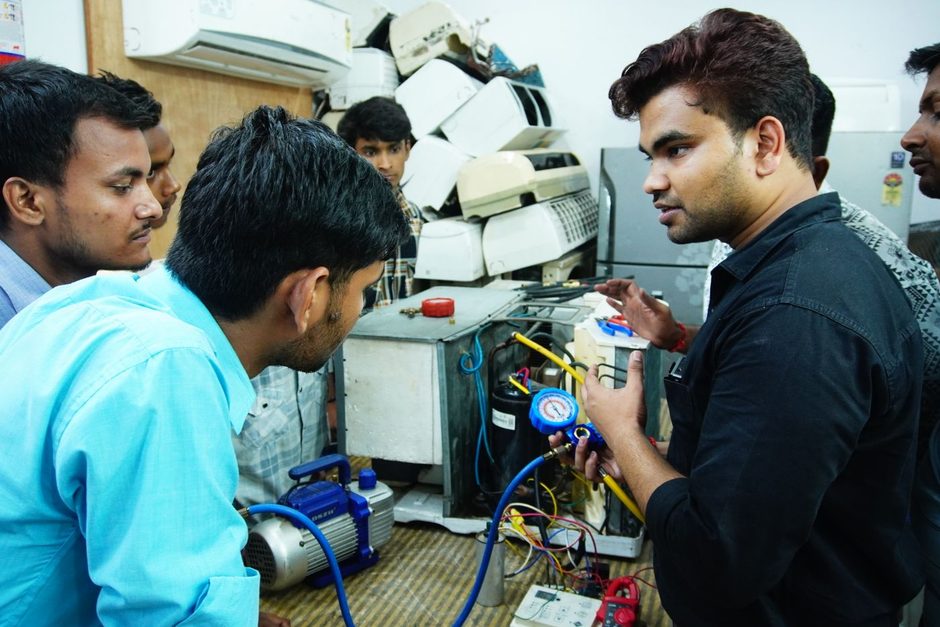
Summer in Brisbane does not wait for your remarketing list to mature. A strata manager in Parramatta will call the first contractor who answers, shows a licence, and can quote a split system without a 14-field form. If you run marketing for an HVAC or aircon company in Australia, that is the job: dispatched work at a cost the van can actually carry, not a dashboard full of “leads” that never pick up.
Search CPCs in trade services have climbed year-on-year - internal account data across our HVAC clients put average cost-per-click in the $2.80-$3.20 range in early 2026. Google Ads and Meta still print useful blended ROAS in many industries, but those numbers are not your P&L. Your number is cost per booked callout, install, or service agreement in AUD, after the dispatcher has said yes. Digital marketing for HVAC and aircon Australia only works when every dollar knows which of those three jobs it is buying.
Why a $180 after-hours callout and a $14k ducted install cannot share one campaign
Most HVAC accounts in Sydney, Melbourne, and Perth still dump “air conditioning repair”, “ducted reverse cycle”, and “commercial HVAC maintenance” into one Search campaign because the brand is one brand. Smart Bidding then averages them. You get a blended CPA that looks respectable until the ops manager asks why the board is full of $90 callouts and empty of plant replacements.
Emergency work is a phone-first, same-day product. Maintenance is a calendar product: strata, facilities, and homeowners booking a service window. Replacement is a quote product with a longer cycle, photos of the existing plant, and a site visit. Mix them and you teach Google that a cheap form fill equals a sold condenser.
High CPC pressure is real. Plenty of new accounts go back to manual bidding because automated bidding looks like it is inflating spend. Sometimes it is. More often the conversion you fed it is junk: a “book now” event that fires on thank-you for a brochure download, or a call of 8 seconds from someone asking if you do refrigerators. Lose 20%+ of conversion data to ad-blockers and privacy gaps and the algorithm has even less to work with. Clean signals beat clever bid strategies.
If someone tells you they will “just send traffic to the homepage”, treat that as a walk-away. Homepage copy tries to be every trade at once. Dedicated pages that match the query (after-hours repair in the Inner West, ducted quotes for new builds on the Gold Coast, commercial PM contracts in the CBD) are how you keep Performance Max from shopping the cheapest conversion.
Creative on Meta is the targeting now. Tight lookalikes from 2020 do not move the needle the way they used to. Run broader, then let the hook do the sorting: a 15-second clip of a tech pulling a dead compressor in 38-degree heat will not attract the same person as a quiet walkthrough of a ducted install in a new display home. Fatigue shows up in CPM first, then in lead volume. UGC-style spots can peak in 5-6 days. If you are still swapping a static “10% off servicing” banner once a quarter, you are not in the auction.
If the mix is already messy, a short paid search review against job type (not against last-click ROAS) usually shows the leak in a week.
The Australian HVAC stack that actually books vans, not enquiry forms
Start with intent, not channels. Map every high-value query to one job, one offer, one page, one conversion. Then hang Google Ads, Google Business Profile, organic, and Meta off that map. Do not add TikTok because a webinar said cold traffic is cheaper there until the Google account has negatives, call length filters, and landing pages that pass Core Web Vitals. According to Chrome UX Report (CrUX) / HTTP Archive reporting, only a minority of origins pass all three Core Web Vitals - HVAC sites stuffed with gallery sliders and unoptimised before/after photos are often in the failing half, and mobile INP is where quote forms die.
Zero-click search is not theoretical. According to SparkToro / Datos (2024), roughly 60% of Google searches in the US end without a click - a trend likely to grow with AI Overviews. AI Overviews appear on a growing share of high-intent queries - we’re seeing CTR drops of 20-35% on service pages that used to own position one. You still need to rank and to be the brand cited. Thin AI pages will not get you there. Information gain (the specific suburb, the licence, the after-hours window, the refrigerant you actually stock) is what separates a useful service page from sludge.
Attribution will lie if you let it. Last-click double-counts. In-platform Meta CPA will not match the job sheet. CM360-style views from Google have been getting noisier. Use platform numbers to steer creative and queries. Use dispatched jobs, quoted jobs, and won installs (with UTMs and call tracking) to decide budget. Unified measurement sounds grand. For a 12-van company, a weekly sheet that matches spend to jobs by postcode is enough to stop you scaling the wrong thing.
Audit scorecard
- 1 Split the three businesses Build separate campaign and page clusters for emergency repair, planned maintenance, and replacement or new install. Different bids, different hours, different proof. Never let one conversion action represent all three.
Build separate campaign and page clusters for emergency repair, planned maintenance, and replacement or new install. Different bids, different hours, different proof. Never let one conversion action represent all three.
Add “DIY”, “course”, “salary”, “manual”, suburb names you do not cover, and brand names you cannot legally service. Review search terms weekly until the waste line is boring.
Add “DIY”, “course”, “salary”, “manual”, suburb names you do not cover, and brand names you cannot legally service. Review search terms weekly until the waste line is boring.
Checklist
-
Make the phone the conversion that matters
Count calls over a minimum duration (you pick 45 or 90 seconds based on how your CSAT actually sounds). Forward from ads and GBP to tracked numbers. Do not fire a conversion on button click alone.
-
Match the ad to a dedicated page
Emergency ads go to a click-to-call page with licence, response window, and suburbs. Install ads go to a quote form that asks system type, home vs commercial, and photos. Homepages are for brand, not for $12 CPCs.
-
Feed first-party signals
Turn on Enhanced Conversions, keep GTM clean, and send offline wins (quoted, booked, installed) back when you can. That is how you offset the 20%+ signal loss. “Creative is your targeting” on Meta only works if Event Match Quality is not a ghost town.
-
Speed and proof on mobile
Compress tech photos, kill auto-play galleries, keep H1 and click-to-call above the fold. If INP is ugly, Smart Bidding is bidding on people who never finish the form. Use HeyLead Insights to watch where they stall (map widget, licence PDF, or a suburb dropdown with 400 options).
-
GBP is a job engine, not a listing
Categories, services, photos of vans and plant, Q&A, and review replies in Australian English. “Open now” and after-hours posts during heatwaves. Do not siphon Maps clicks to a slow homepage.
-
Meta only after the offer is sharp
Broad targeting, few ad sets, creative that names the job (same-day split-system repair in Western Sydney, not “HVAC solutions”). Refresh before CPM creeps. Do not scale spend during learning swings at $40 a day.
Action checklist
- Export 90 days of jobs from the board. Tag each as emergency, maintenance, or replacement, then tag suburb and revenue. That file is your budget bible, not last-click ROAS.
- Rewrite three landing H1s to the job and the city. Example: “Same-day aircon repair in Brisbane’s inner suburbs, licenced, after hours.” Check titles and H1s with the tools below before you spend another dollar.
- Build UTMs for every ad, GBP post, and organic CTA so the dispatcher can see source without opening Ads Manager.
- Add negatives and pause any keyword whose search terms are DIY or employment. Broad match with Smart Bidding on a clean negative list can reduce wasted CPC spend - Google cites efficiency improvements but results vary; audit search terms weekly to verify.
- Film two phone-shot videos this week: one emergency, one install. Run them broad. Kill the loser when CPM rises and lead quality does not.
Free tools - try these yourself
Get a free marketing audit - we review your search, ads, and landing pages and send back what to fix first.
Get a free audit
What broke for a Melbourne install team (and the one page change that fixed it)
A Head of Marketing at a 9-van reverse-cycle installer covering the eastern suburbs had Google Ads “working” at a $47 CPA. The board told a different story. Almost every form was a renter asking about a wall unit the landlord would not pay for. Search terms were fine. The landing page was not. It opened on “Melbourne’s trusted HVAC experts” and a generic quote form with no tenure question.
They added one field (owner, landlord, strata, tenant) and routed tenants to a short “we can inspect, we bill the owner” path instead of a full design consult. Form volume dropped 22%. Booked site visits rose. That is the mechanism: the campaign was not stupid, the page was inviting the wrong commercial relationship. CRO lifts of the size you see in case studies come from removing the wrong visitor, not from a new button colour.
A second pattern shows up in Perth summers. A founder running Meta for after-hours repairs watched CPM climb for 11 days while lead count held, then both fell off a cliff. The creative was a static rebate graphic. They swapped to a 12-second clip of the after-hours van and a real after-hours number on screen. Spend stayed flat. Booked jobs came back. Fatigue was real, not “Meta gaslighting”. Ads dying in days is normal now. Treat creative like stock that spoils, not like a brand asset you polish once.
Do not promise a specific ROAS or CPL before you have seen the account, the pages, and the unit economics of a callout versus an install. Honest programs take 3-6 months to stabilise. Anything that “rockets sales from the first reel” is someone else selling you a 2024 playbook in 2026.
Patterns we see across accounts
We were celebrating cheap Search CPLs until dispatch showed most calls were under 20 seconds. Changing the conversion to 90-second calls doubled CPA overnight - that was the first honest number on the board. Across HVAC accounts, duration-based call conversions are how you stop Smart Bidding from buying tyre-kickers.
Broad Meta with two job-specific videos has repeatedly beaten stacked lookalikes. The lookalikes were recycling people who already booked a filter clean. Creative that names the job (after-hours repair vs new install) does the sorting lookalikes used to do.
FAQs
Should HVAC companies in Australia put most budget into Google Ads or Meta?
Put intent budget (emergency and high-intent install terms) into Search and Maps first. Use Meta when you have a clear offer and creative you can refresh. Cross-industry ROAS is a compass, not a forecast for your vans.
Is Performance Max safe for aircon leads?
It is safe when asset groups and URLs are split by job type, brand exclusions are in place, and you are not converting on junk events. It is not a dumpster for leftover budget. “Performance Max drives the bulk now” only in accounts that already taught it what a dispatched job looks like.
Why did automated bidding look like it wasted money?
It optimised to the conversion you gave it. If that conversion was a form or a tap-to-call with no duration, it will buy volume. Fix the signal, then give the bid strategy two to three conversion cycles before you yank it back to manual.
Do we still need keywords if “signals over keywords” is the line?
Yes. Google still needs a query skeleton, negatives, and intent clusters. Signals (Enhanced Conversions, offline wins, first-party CRM) improve bidding. They do not replace “do not bid on HVAC jobs Darwin” when you only cover Adelaide.
How fast should we expect SEO to fill the calendar?
Local pages and GBP can move faster than national content. Realistic organic contribution is months, not a week. Chase citation-worthy, suburb-specific pages over volume. Volume is a dead metric if the page cannot win the click or the AI mention.
Putting it to work
Execution sprint
This week
- Pull 30-90 days of performance for HVAC and aircon firms in Australia (Search Console, ads, CRM, or call logs - whatever you have).
- Flag the top leak: wrong intent, weak page, slow response, or dirty conversion tracking.
- Ship one fix on the highest-traffic money path (page, campaign split, or response rule).
- Run the free tools below on that same URL or account and log the findings.
Free tools for this sprint
Next 30 days
- Expand the fix to the next one or two money paths only after the first one shows cleaner bookings.
- Align creative, keywords, or content with the same offer the page now states.
- Review booked outcomes weekly; cut anything that still only produces unqualified volume.
Pull the last 60 days of dispatched jobs, tag them emergency / maintenance / replacement, and line them up against campaign and landing URL. If one URL is buying all three, that is your first rebuild.
This week
-
Add duration-based call conversions and pause the tap-only ones.
-
Write negatives from the last 30 days of search terms.
-
Ship one job-specific landing H1 and test it with the H1 and title checkers.
-
Run Core Web Vitals on the money pages, mobile only.
-
Record one emergency video and one install video for Meta.
-
Stamp UTMs on every live ad and GBP post.
Next 30 days
-
Stand up three page clusters and stop sending paid traffic to the homepage.
-
Send won jobs back as offline conversions where the CRM allows it.
-
Refresh Meta creative on a 5-7 day loop while CPM is still behaving.
-
Reconcile Ads Manager to the job sheet every week, not at month end.
-
If you stall, use the free audit before you raise budget.
HeyLead will take the ugly middle off your plate: the job-type campaign split, the landing pages that match the ad, and the conversion setup that stops Smart Bidding from treating a 12-second call like a sold ducted system. Chat with us on WhatsApp
Free marketing audit, or reach Martin directly:
Get a free audit Connect on WhatsApp · [email protected]